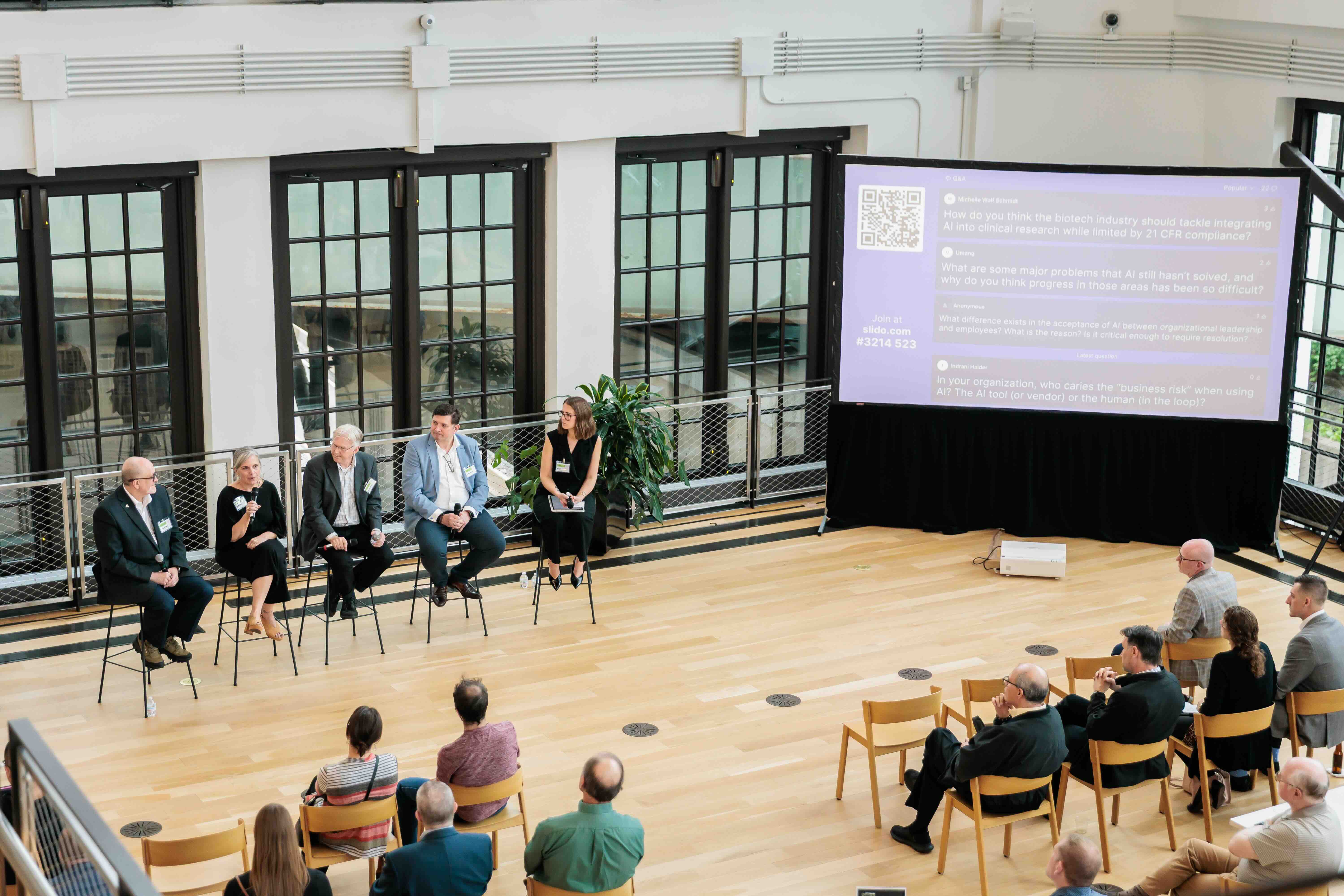
Last week, a room full of people who work in Pittsburgh's human health innovation ecosystem sat down to talk honestly about what's actually happening out there. Not the conference version, but the real one.
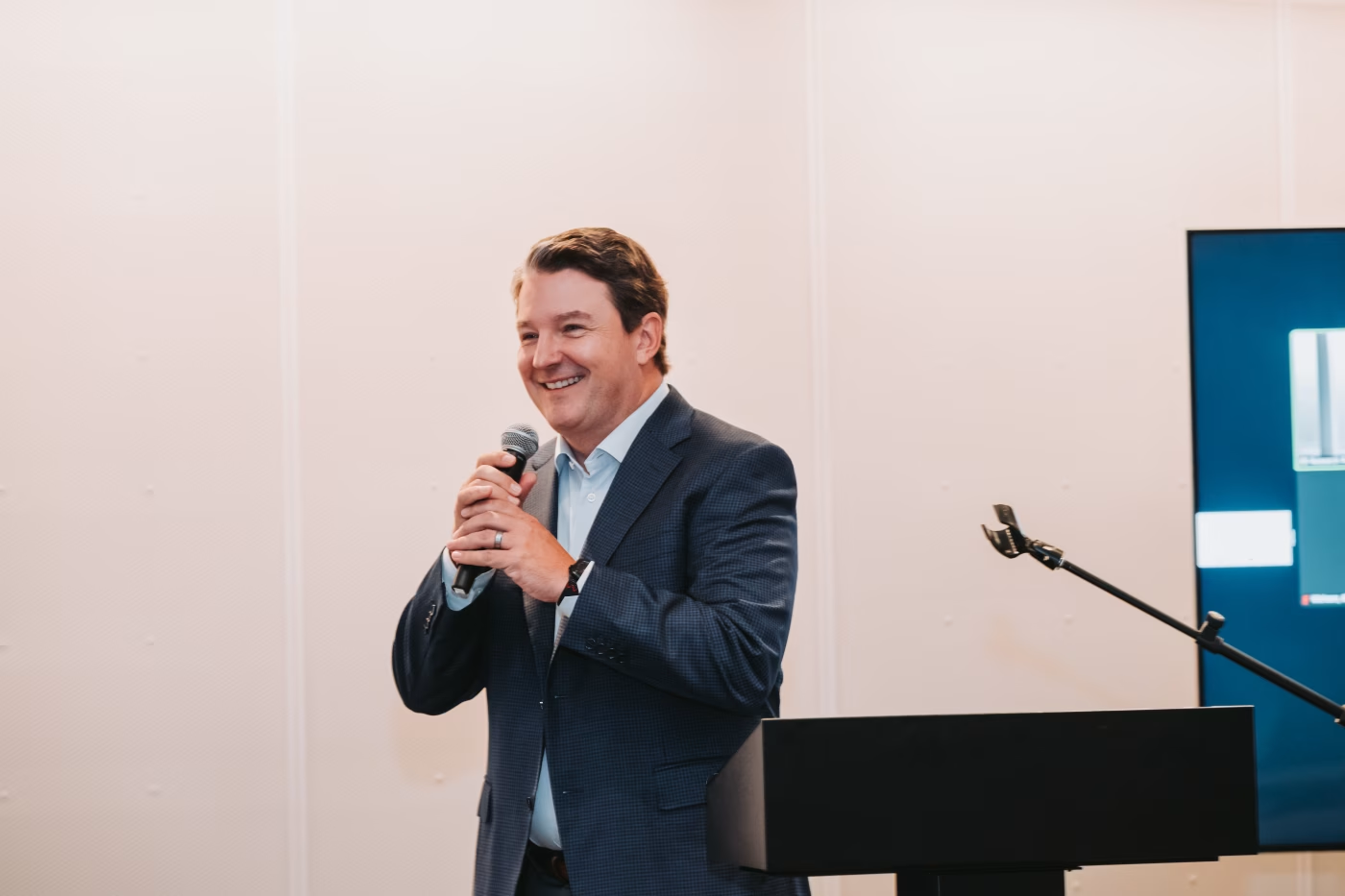
The AI in Action panel hosted by the Pittsburgh Life Sciences Alliance (PLSA) at The Assembly brought together Dr. Hooman Rashidi (Associate Dean of AI in Medicine, University of Pittsburgh School of Medicine), Michelle Skinner (Chief Clinical Executive, TeleTracking), Barr von Oehsen (Director, Pittsburgh Supercomputing Center), and Matthias Baumann (Segment Leader, Digital Solutions + Connectivity, Philips) as panelists. The panel was moderated by Annie Saunders of Morning Brew, and the audience included clinicians, technologists, founders, and policymakers.
The tools are working. The infrastructure isn't ready for them.
Dr. Rashidi described cutting bone marrow diagnostic write-up time from 30 minutes to 5-6 using an AI tool his team built and brought through Pitt's AI governance review. The tool works. Practitioners are using it. But it isn't deployed system-wide — not because anyone doubts it, but because most healthcare IT infrastructure is built for cloud-based vendor frameworks running on CPU and storage, rather than locally deployed GPU compute.
The gap is structural, and it's not closing as fast as the technology is moving. Von Oehsen put the scale of the problem in concrete terms: a single AI compute rack used to run on roughly 10 kilowatts. Projections now put it at one megawatt per rack. This means serious AI work requires data centers measured in tens or hundreds of megawatts that most universities and hospitals simply cannot support.
The governance problem is bigger than most organizations admit.
Baumann shared internal data from Philips' Pittsburgh operation: 94% of employees are uncertain which AI tools they're allowed to use and less than 10% feel confident in their AI maturity. Roughly 30% use AI daily. The risk is proprietary data leaving the organization through unsanctioned tools. Philips' response includes a Pittsburgh-based Center for Applied AI and an education program that just launched.
The organizations getting ahead of this are treating AI literacy as infrastructure. Pitt's no-code AI Academy, modeled on a Cleveland Clinic deployment and designed for users without a machine learning background, enters live deployment within weeks. Rashidi credited Pitt's Jason Rosenstock with the simple framework Pitt utilizes to teach responsible AI use: Disclose, Verify, Protect. The Pittsburgh Supercomputing Center (PSC) is leading conversations across the Commonwealth about what statewide AI workforce development looks like at scale.
These are the right moves, but they aren't yet happening at a pace that lets anyone treat them as a regional standard.
Pittsburgh has the assets most cities would build a strategy around.
The PSC is one of the top facilities of its kind in the world. Funded by the National Science Foundation and National Institutes of Health, its services are free for open science and available to industry at cost recovery — meaningfully cheaper than commercial cloud. The PSC currently runs 40 industry-sponsored studies and is seeing growing inbound interest from life sciences startups. Most people in Pittsburgh don't know that.
That's the convergence in plain view. UPMC and Highmark Health cover 11M+ lives between them. Carnegie Mellon — the birthplace of AI — and the University of Pittsburgh share one square mile and collaborate by design. Abridge, built here on top of CMU's AI talent and UPMC's clinical data, is now used in 250+ health systems nationally. TeleTracking is deploying computational twin technology with health system partners to take administrative load off nurses and operations teams. Philips anchors a meaningful share of its applied AI work here. Krystal Biotech has an $8.83B market cap as of May 2026 and has the third best-selling gene therapy globally.
Rashidi put the communications problem honestly: The PSC and the broader ecosystem are getting better known "thanks to Megan and her group" — referring to PLSA CEO Megan Shaw — but the work of telling the story at the scale of what's actually here is ongoing. Boston and San Francisco aren't more capable. They've been more practiced at saying so.
The final mile is the hard part.
Skinner, who relocated to Pittsburgh from Montana last year specifically because of this ecosystem, put it simply: Pittsburgh has 98% of what it needs. The last 2% is converting theory into production. Tools that work in beta but don't make it to system-wide deployment. Capabilities that get built and then maintained by teams too stretched to optimize them. Partnerships that form in conference rooms and stall before they create anything durable.
That's the work. Less exciting than the technology, but more important than almost anything else.
Pittsburgh is having the right conversation. The infrastructure gap, the governance deficit, the talent pipeline challenge… the people in that room understand the problems clearly. The ecosystem is here. The question is how this community builds the coordination layer to make it function as one.
Get insights delivered to your inbox.
Enter your email to get access to the resource
Access directly from its original publisher.